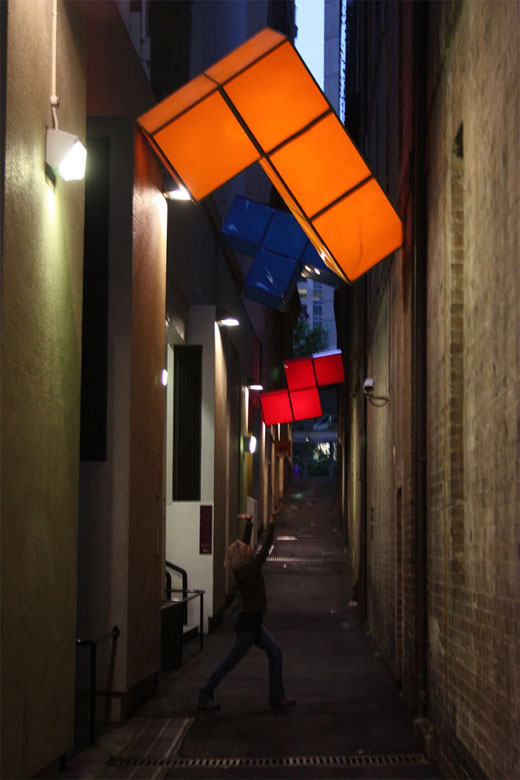
Artists from the Gaffa Gallery installed a series of falling giant Tetris pieces in an alleyway in Sydney. They write:
There are grand implications of error here that lead to questions, such as who exactly has been playing Giant Tetris? What were they trying to do? Could I have done better? Is the city grid similar to a computer game or different? What brain-space am I in when I’m playing games on my computer? Is it more or less alert than when I’m waiting in line for a sandwich? The work seeks to challenge conceptions of the North end of Sydney’s CBD as an orderly, socially cold grid and beckons viewers to assess their own level of interaction, play and hacking within the city
Tired of seeing the abandoned eyesore on a daily basis, artist Jennifer Marsh decided to cover this old gas station in 5,000 square feet of fabric.
With the help of professional and amateur artists from 15 countries and more than 2,500 grade-school students in 29 states, Marsh covered the 50-year-old former Citgo station — pumps, light stands, signs and all — with more than 3,000 fiber panels that are crocheted, knitted, quilted or stitched together.
What the gas station looked like before the project.
Video of the installation:
More photos and behind the scenes info are on the artist’s website.
The project consists of an eight-foot (2.5m) long industrial robot arm, costumed to resemble an enormous inchworm or elephant’s trunk, which responds in unexpected ways to the presence and movements of people in its vicinity. Sited on a low roof above a museum entrance, and governed by a real-time machine vision algorithm, Double-Taker (Snout) orients itself towards passers-by, tracking their bodies and suggesting an intelligent awareness of their activities. The goal of this kinetic system is to perform convincing “double-takes” at its visitors, in which the sculpture appears to be continually surprised by the presence of its own viewers — communicating, without words, that there is something uniquely surprising about each of us. Double-Taker (Snout) is currently active at the Pittsburgh Center for the Arts, where it will be on display through early August.
Check out this flickr set for behind-the-scenes photos of this project’s creation.
A student group in Poland executed a series of projects where they used the lights in their dorm room to create awesomeness. In the above video you can see a game of Snake and a bit of Pong at the very end. Their YouTube channel has several other videos, including this James Bond video:
There have been several examples of students using the same technique to create massive games of Tetris. Here’s a video a Russian group that pulled it off:
Man on Wire is a new documentary currently in limited release about an amazing stunt that took place at the World Trade Center in 1974.
On August 7th 1974, a young Frenchman called Philippe Petit stepped out on a wire suspended between New York’s twin towers, then the world’s tallest buildings. After an hour dancing on the wire, with no safety net or harness, he was arrested and thrown into an underground prison. Until that moment no one but Petit and his team of accomplices, who had spent months planning their illegal ‘coup’ (as they referred to it amongst themselves) knew anything about it.
Born out of a dream and an idea, Petit and his team of accomplices spent eight months planning the execution of their ‘coup’ in the most intricate detail. Like a team of professional bank robbers planning their most ambitious heist, the tasks they faced seemed virtually insurmountable: they would have to find a way to bypass the WTC’s security; to smuggle the wire and rigging equipment into the towers; to suspend the wire between the two towers; to secure the wire at the correct tension to withstand the winds and the swaying of the buildings; to rig it secretly by night – all without being caught. Not to mention the walk itself…
An MIT-designed building with walls made entirely of water was unveiled Thursday at the opening of the Zaragoza World Expo in Spain.
From their press release:
The “water walls” that make up the structure are generated by high-speed computer controlled solenoid valves. They can be programmed to take varying shapes, to display patterns, images and text, and to respond dynamically to input from sensors.
“This capability enables architects to challenge many traditional ideas about architectural form,” says Mitchell. “Doors, for example, need not have fixed locations. When you walk up to them, water walls can open like the Red Sea for Moses, and then seamlessly close behind you.”
“The Digital Water Pavilion illustrates how buildings of the future may change their appearance and form from moment to moment, based on necessity and use,” says Ratti. “It is not easy to achieve such effects when dealing with concrete, bricks and mortar. But this becomes possible with digital water, which can appear and disappear.”
Urban Prankster covers pranks, hacks, participatory art, flash mobs, and other creative endeavors that take place in public places in cities across the world. It is edited by Charlie Todd.
Recent Comments